
The Day of Rest
Why I Observe The Sabbath and Work on Sunday. And Sometimes Run in the Sanctuary!


This essay is an attempt to trace a development that, while not entirely without merit, has taken on a life of its own. I believe it is detrimental to our understanding of the Gospel and I will try to show why I believe this to be the case. Much has already been written on this subject, and I owe a great deal to writings over a hundred years old and to historical research on the Telegram channel Trails of the Past.
History of Lord’s Day Rest Requirements
In about AD 60, Paul the Apostle wrote these words to the church at Colosse, “Therefore do not let anyone judge you by what you eat or drink, or with regard to a religious festival, a new moon celebration or a Sabbath day. These are a shadow of things that were to come; the reality, however, is found in Christ.”
The early church had this point clear- Jesus Christ is the fulfillment of the Sabbath rest. We, by accepting His completed work, enter His rest and cease from our own works. Just as His death provided the perfect sacrifice, His Sabbath rest is also given to those who are risen to new life in Him.
Before AD 300, many Christians of Jewish background still observed the Jewish Sabbath, although not as a requirement, for many Gentile converts had no such custom. For Jew and Gentile believers alike, the first day of the week was designated “the Lord’s Day” and was the day the church gathered for encouragement and the Eucharist meal. These meetings were held in the early morning and evening, often both times, but not always. In between the gatherings Christians filled their day with ordinary work.
The earliest Christian writings are united in their attitude toward observance of the Lord’s Day. At the end of the second century, we find an outlier in Tertullian, who mentions rest, stating, “we postpone business lest we give any place to the devil.”1
Over the years a change can be observed, best described as a merger of Sabbath and Lord’s Day. In AD 321, Emperor Constantine made the Day of the Sun a national holiday, when shops were to close and people were to rest. Around AD 330 Eusebius of Caesarea wrote that the Sabbath requirements had been transferred to the Lord’s Day. The Council of Laodicea in AD 364 decreed that, when possible, work was to be avoided. Christians were not obligated to rest, but rest was preferred.
The sixth century saw increasing use of the fourth commandment as basis for Lord’s Day decrees. Caesarius of Gaul required rest on the Lord’s Day in AD 540. In the late 500’s Martin of Braga outlawed all work on the Lord’s Day, based on the fourth commandment. The Council of Rouen in AD 650 was the first church council to explicitly decree a 24-hour rest period. Similar requirements were eventually adopted across Europe.
Through the centuries, Sunday kept its place as the day of rest in Europe. By the 1500’s both secular rulers and church courts enforced Sunday rest. However, there were dissenters. The Martyr’s Mirror records interrogations of Anabaptist brethren who insist that the Sabbath is no longer to be observed literally, but spiritually. Concerning Sunday observance, we find a variety of responses. Mennonites in Holland in the 17th century were known to reject the Sunday Sabbath of the surrounding Reformed communities and return to work after Sunday meeting.2
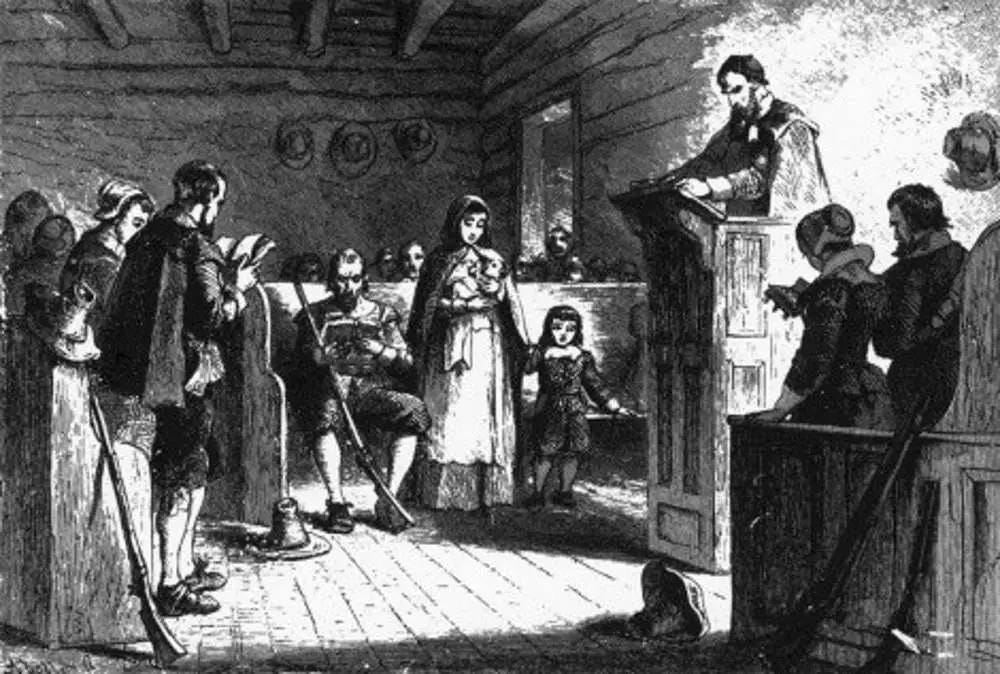
The reformers left Sunday requirements intact but differed in their reasoning. John Calvin was the strongest Sabbatarian and exerted the greatest influence on North American settlers through migrations of Calvinist groups; Puritan, Dutch Reformed, and Presbyterian. This influence surfaces in the Blue Laws adopted by many states regulating Sunday activity and prescribing moral conduct.
A Shift Toward a Protestant Attitude
My Mennonite ancestors settled the American frontier following and alongside Presbyterians and other Protestants. Around the beginning of the twentieth century, despite the Blue Laws and Protestant environment, we find a pronounced conviction in the writings of Church of God in Christ, Mennonite leaders against the transfer of literal Sabbath rest to Sunday. This remarkable opinion testifies to a deep disconnect from the Sabbatarian views of mainstream Protestantism. Of course, the writers were careful to encourage obedience to the laws of the land.3
The influence of John F. Funk on the Mennonite church can hardly be overstated. After his conversion in 1858 at a Presbyterian revival, he became closely associated with revivalist D. L. Moody. This influence was profound and left a permanent mark on American Mennonites through Funk’s great energy and talent. The revivalist methods, zeal for Sunday schools, and Sabbatarianism learned from Moody were promoted in the periodical he founded in 1864, Herald of Truth. This became a common household paper for over forty years among both Mennonites and Amish.4 The anti-Sabbatarian polemics of turn-of-the-century COGICM leaders are better understood against the backdrop of increasing Protestant influence in the broader Mennonite community.
In contrast to COGICM convictions, the Mennonite Brethren’s 1902 Statement of Faith, addressing the Lord’s Day, gave Article 7 this title, “Concerning the Christian Day of Rest.” The Evangelical Mennonite Church referred to Sunday as the Christian’s Sabbath in 1917. These are the first of many appearances of Sabbatarian language among North American Mennonite confessions of faith.5
The question, “May it be permitted to do field work on Sunday?” was brought before the 1917 General Conference of the Church of God in Christ, Mennonite. This resolution was reached, “for the sake of order we observe a day of rest and according to the word of God, ‘to give none offence, neither to the Jews nor to the Gentiles, nor to the Church of God.’” Take note of the reasons, “for the sake of order” and “to give none offence.” No trace of fourth commandment reasoning appears.6
Between the years of 1900 and 1930, a marked difference becomes apparent in the articles appearing in Botschafter der Warheit and in Messenger of Truth. Earlier articles reflected the more primitive attitude that literal Sabbath observance belongs to those works of the law fulfilled by Christ. By the late 1920’s, though, strong language was appearing, insisting on Sunday as a day of obligatory rest. Anecdotes about great rewards for leaving fieldwork until the following day were published. At this point, we can only speculate about what might have been the catalyst for this shift toward Protestant sentiment. Obviously, other Mennonite churches were strongly influenced by John Funk’s Herald of Truth, and this in turn created pressure to not be seen as permissive and lax in piety.7
Another major development was the gradual decline in use of the German language, and widespread use of English hymnals. These contained such Sabbatarian hymns as “Safely Through Another Week” by John Newton, an Anglican, “O Day of Rest and Gladness” by Christopher Wordsworth, another Anglican, and “O Holy Day” by Elisha Hoffman, a Presbyterian.
Moving several decades forward we find the 1959 General Conference reaffirming the 1917 resolution and adding this distinctly Sabbatarian wording, “Be it further resolved, that in all we think, do, or cause to be done, it should be to hallow the Lord’s Day.”
By the time I was born, the merger of Sabbath and Sunday was complete and taken for granted. Stories for children were read wherein violators of the fourth commandment suffered drastic consequences. Sports and pastimes were curtailed. Field work was permitted under no circumstances and experiences were shared of harvests left to threatening weather over a Sunday and being miraculously spared. During busy seasons, in some congregations, engines went silent at midnight and restarted 24 hours later.
Parallel Developments in Ukraine
The focus of this essay is North American Sabbatarianism, but the 19th century brought similar developments to Mennonites in Ukraine. Several reforms took place in that era. Three notable movements were the Kleine Gemeinde, Krimmer, and Mennonite Brethren revivals. In old diaries and anecdotes, we find relatively new Sabbatarian sentiment among these groups, although varying in degree, in contrast to the more permissive attitudes toward the Lord’s Day in the surrounding Grosse Gemeinde.8 Reform among Mennonites, perhaps through outside influence, seems to bring Sabbatarian tension in its wake.
Selling the New While Using the Old
Imagine an old-fashioned door-to-door salesman selling a newly patented device. His sales pitch is convincing, and his demonstration is executed perfectly. The potential customer is reaching for her checkbook, but asks, offhandedly, “Do you use the Clean-o-Matic?”
The salesman stammers, because to be honest, he uses the old Scrub-o-Blister. He senses hesitation from his would-be customer. If he admits to using the old design he will probably lose the sale.

My parable is based on a better one from the New Testament. “No one sews a patch of unshrunk cloth on an old garment, for the patch will pull away from the garment, making the tear worse. Neither do people pour new wine into old wineskins. If they do, the skins will burst; the wine will run out and the wineskins will be ruined. No, they pour new wine into new wineskins, and both are preserved.”
Would a man building altars and sacrificing calves leave a clear testimony of Christ’s perfect and final sacrifice? Does building a Temple enhance the message of God dwelling with man, and the veil between us torn from top to bottom? Will stopping all work and play and “hallowing” a sacred day somehow convey the astounding news of perpetual rest from sin in Jesus Christ? In each case, it is not possible to convincingly do both. When the New Testament tells us a law is fulfilled by Christ, we do not advance His kingdom by continuing to labor to fulfill it ourselves.
Now don’t get me wrong. Rest on Sunday, or work. I have strong instructions to refrain from judging you. But please do not attach Sabbath law to the Lord’s Day. Or insist that your brother rest. Or advise a poor brother in a poor country to desist from needed income on Sunday. Our rest transcends a day without work. It is the Believer’s Rest, provided by the work of our Saviour. The new wine cannot be contained in the old wineskin.
The same principal applies to God’s House. “Don’t you know that you are God’s temple and that God’s Spirit dwells in your midst?” His people are His house! The building and dedicating of “houses” for God has developed in a way similar to that of the Sunday Sabbath, from clear conviction against, to widespread adoption, to unthinking acceptance, to requirement.9 We should be free to build meeting houses or not build them, but we could at least stop calling our meeting house “God’s House.” Never cloud the reality of God With Us by confining His presence to a day or a place.
Bercot, David. A Dictionary of Early Christian Beliefs. Hendrickson Publishers, 1998
Harline, Craig. Sunday, A History of the Lord’s Day From Babylonia to the Super Bowl. Doubleday, 2007.
Mininger, Hiram. (1909, Sept.) Messenger of Truth.
Holdeman, John. (1905, Sept.) Prophecy. Messenger of Truth.
Bender, Harold S. “Funk, John Fretz (1835-1930) Global Anabaptist Mennonite Encyclopedia Online
Loewen, Howard John. One Lord, One Church, One Faith, and One God, Mennonite Confessions of Faith in North America, an Introduction. Institute of Mennonite Studies, 1985
COGICM. Conference Reports. Gospel Publishers, 2004
Because of secular enforcement of a day without work, idleness brought opportunity for many activities, some less than wholesome. This provided motivation for introduction of Sunday Schools and additional Sunday worship services, and prompted warnings about worldly pastimes on the Lord’s Day.
Plett, Delbert F. The Mennonite Kleine Gemeinde Historical Series 7 Vols.
Amen. The mixing of the old and new covenants is actually unbelief or ignorance of the finished work of Christ and leading of Holy Spirit in the Kingdom of God. Hebrews 4:1-11 Galatians 3:1-3.
May God bless you for sharing.
I appreciate this article. I had begun writing a rather lengthy essay on the matter myself, but I'm glad that I won't have to finish it, since another has done so, and I'm not so good at writing in English. On my website, I have a few shorter articles on this topic, but they are in French and not aimed at Church members. Bob Goodnough also has a number of posts on this topic on flatlanderfaith.com. Concerning the 1959 Conference, which word makes it Sabbatarian? "Hallow"? Surely not the "Lord's Day"? That expression only appears once in the Bible, in Rev 1:10, where the meaning is maybe ambiguous, but Church leaders from Ignatius on used that term to describe Sunday and not the Sabbath. Romance languages also usually use that term as the word for Sunday: Dies Dominic's = Dimanche, Domingo, Domenica, Duminica. Also, the word for Saturday in all those languages is related to Sabbath, which shows that even as those languages formed in the middle ages, there was a clear knowledge that Sunday was not the Sabbath.